The goal was to create a piece of photography which reflected the issue of climate change.
This describes my process. Here I outline the steps that I will describe in detail stage by stage, step by step.
Step 1: The brief
In May, I was asked to take part in a storytelling project at Oxford City Farm. A researcher had visited the land as he wanted to capture some photos for his research paper. At the same time the farm thought that this was a brilliant opportunity to involve volunteers in his photography. So, we were asked to pose in front of the camera.
I had to remain as still as possible for 2 minutes, just enough time for the camera to take in light.
I started the process of contributing to the Storytelling & Photography Project, by researching some photographs that the invited photographer had taken of the farm previously. The image you’ll see here [https://www.instagram.com/p/DShjqgdDMCo/], contains the farm fence and the trees by the primary school located behind the farm; the farm shed can be seen at the back of the photo. I was taken by how striking the light and contrast were in this photo.
There is a dazzling sky and dingy trees. So this bright sky comes to the fore as the sky is empty, so there is not anything to produce darker images such as birds leaving the top half of the image white and clear. The trees seem black so a juxtaposition occurs between the colours: pure white and dark black.
The whitest part of the photo is at the centre, which almost causes a tunnel effect. I was really inspired by this photo, as natural light was used to incredible effect. The sun here is the main source of natural light. The light here complements what is being captured as it aids the viewer to the centre of the image where the focus is intended to be. This shows how significant the sun is to this image in bringing about a certain style.
I wanted to capture the same lighting effect, to create an even more striking image that draws you into the farm and the goats. The same tunnel effect.
In the image you can view here [https://www.instagram.com/p/DShkIH4jBC6/] I was influenced by the photographer, who took photos of himself holding a camera, with the background of fields behind him. Again, when thinking about my photo that formed part of the project. I also wanted to include the land behind the pinhole camera and looked to hold a goat rather than a camera.
This was so one got the idea of the place still but also got something much more personal than a camera.
Viewers got a volunteer, so me, and an object belonging to the farm i.e. a goat. As opposed to a camera. Which stands in difference to the image because the photographer was coming onto the land with a manmade object.
This was a manmade object, a camera which the photographer owned, so I was trying to shift focus back onto the goat and what the farm is really all about, namely the animals and people who volunteer or work on the farm.
By focusing on the goat and landscape, I wanted people to be drawn to the land and goat and see mine and the goat’s reaction so that they could feel or sense what I felt, the calm and happiness in that moment but also every day I visit the farm, so I wanted to reflect these moments and also bolster the significance of places like this and to invite people to want to do the same.
In this sense I was hoping this would inspire the final image and draw a link of feelings between me holding the goats and the farm at large.
In this image, I also liked the contrast. It’s unclear what the subject is holding, he is actually, holding a camera in his hand and his face is blurry whereas other parts are less blurry. The exposure bleeds around his face, undoubtedly because he was moving and so the light was hitting different parts of the camera obscura, so when the light was being recorded onto the film, it was being dispersed into multiple places rather than the one still place it should have been coming from.
Your eyes are drawn automatically to the dysfunction of the photo and remain for a little while before flitting to something else.
The colour blue faintly brushes over the sky. So you almost feel like your there on the farm on a warm day, you can almost sense the air on your skin. Connecting the photo with nature and the self.
Step 2: The sketch
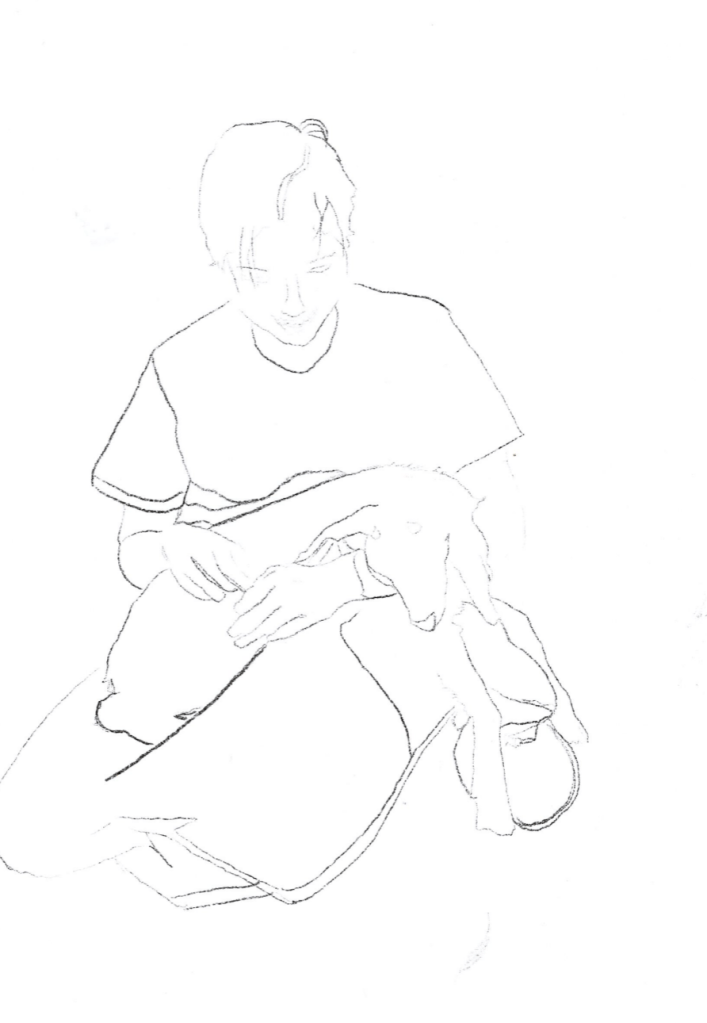
The sketch, which you can see below, illustrates how I have encompassed the ideas that I loved most about the above image, coupled with some ideas I had for poses. I wanted to have a sense of how I would pose, and what the best way to pose was, so that I could see the goat clearly but also my body and the wider environment. By kneeling and cuddling the goat, I realised that I could successfully do both. This later influenced how I would go on to pose in the actual photo – I am cuddling the goat in my arms, and I am standing so that I could capture her face clearly because I knew if I was sitting, I wouldn’t get a close up in the way that I did by standing right next to the camera obscura.
Final image
I am cuddling a goat; she is smiling in the photo, see the photo here: https://www.instagram.com/p/DSNXn6LjMhn/. The image captures happiness and bliss for both parties but most importantly in the goat. Although the sketch is different, both images capture how the animal is at peace, and this feeling is so desperately what I wanted to capture. In the real photo, I brought this out more forcefully by not just sitting but by standing, in essence it gave me more time to think how I could make the most dramatic impact.
Anisah Rokib
 Video
Video 